
Understanding endometriosis as a systemic condition, and what this changes in the way we teach
Key takeaways
- A study published in Nature Genetics in April 2026, conducted on nearly 1.4 million women, confirms that endometriosis is a systemic disease, not only a matter of pelvic lesions.
- “Non-pelvic” symptoms such as fatigue, anxiety, migraines, and digestive disorders are an integral part of the biology of the disease, not collateral effects.
- The genome is not destiny: environment, food, stress, sleep, and life rhythms modulate the expression of the disease.
- This interconnected vision meets what yoga and Ayurveda have been holding for millennia.
- Our role as teachers is to translate this understanding into concrete, targeted, and personalised practices that women can take into their daily lives. This is what we train in EndoYoga.
Many yoga teachers have heard that endometriosis is, above all, a pelvic condition. That it expresses itself through painful periods, and that yoga for endometriosis consists mainly of soothing the pelvis and supporting the menstrual cycle.
A study published in Nature Genetics at the end of April, conducted on 1.4 million women, is the largest genetic study ever carried out on endometriosis. It strengthens our understanding of endometriosis as a systemic condition, and not only a pelvic one.
This raises a question for yoga teachers. If endometriosis is systemic, where does our practice fit into this picture, and how do we adapt the way we teach?
About the study
The word to know: multi-omics
It is a way of looking at biology as a network rather than as a list of isolated genes. The question is no longer simply which gene?, but which gene, in which tissue, producing which protein, in which context?
And what this approach has revealed is what changes our understanding of endometriosis.
A systemic disease, not simply a question of lesion location
The study strengthens our understanding of endometriosis as a systemic disease.
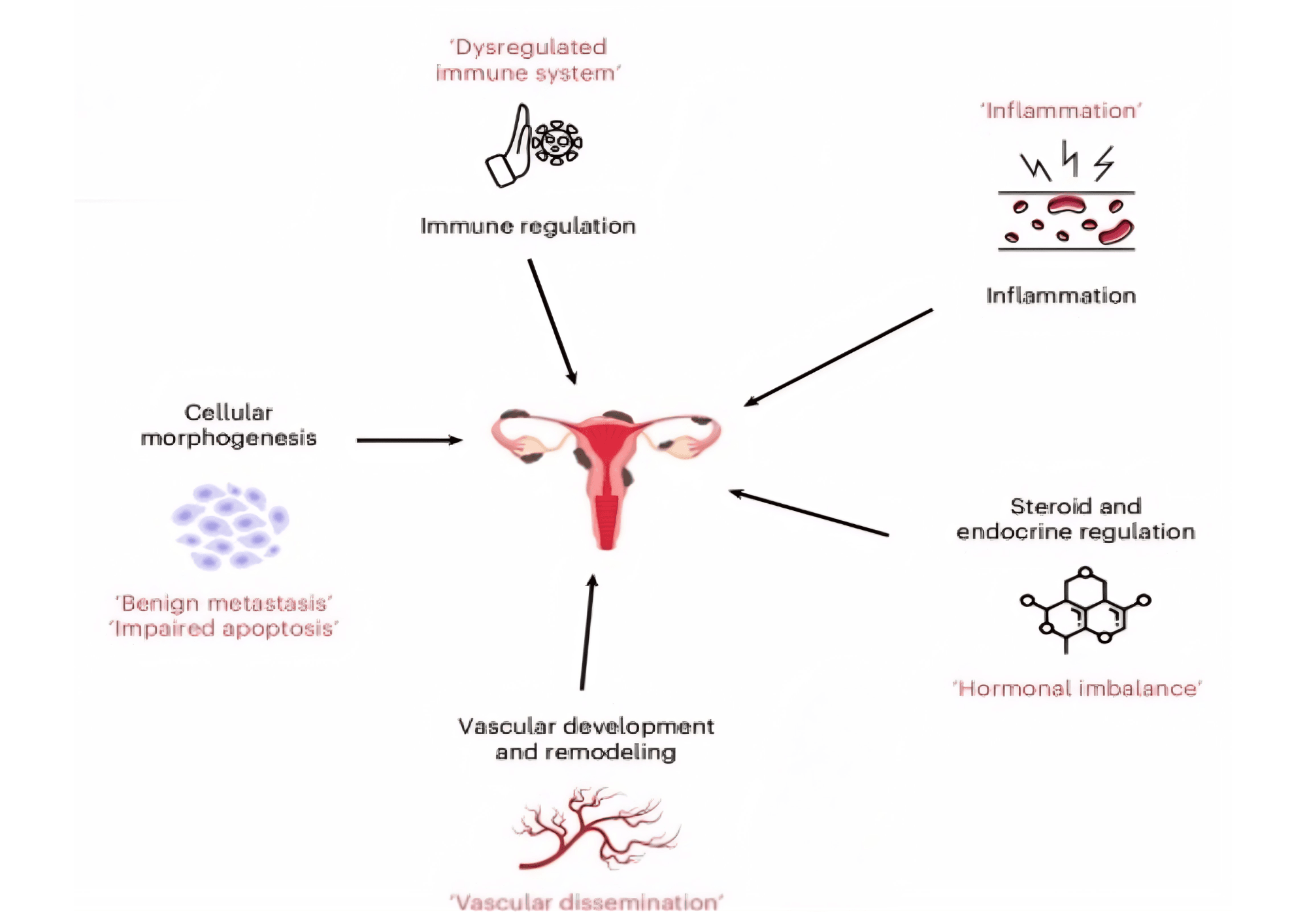
The same biological mechanisms that produce lesions are involved simultaneously in several processes throughout the body:
- immune regulation and chronic inflammation, the way the immune system reacts continuously and maintains a background inflammatory state
- hormonal signaling, the way hormones communicate with each other and with tissues, and trigger or regulate many functions
- vascular development, the way blood vessels form and grow, particularly around the lesions
- tissue remodelling and cellular differentiation, the way cells transform, reorganise, and build or repair the body’s tissues
Endometriosis is therefore not only something that is found in the pelvis or reduced to its lesions. It is a biological dysregulation that travels through the body.
“Non-pelvic” symptoms are part of the biology of endometriosis
The researchers found that the same genetic signatures associated with endometriosis are also linked to conditions previously considered distinct: migraines, anxiety, nausea, chronic abdominal pain.
These symptoms should no longer be seen only as separate or secondary elements. They are part of the very biology of the disease itself.
This validates what we live with when we have endometriosis, and what our students describe to us. Different symptoms for each, that medicine did not always connect back to endometriosis. The fatigue that never lifts. The brain fog. The digestive troubles that resemble IBS. The anxiety. The migraines. The nervous system that seems always on alert.
The genome does not mean a fixed destiny with endometriosis
The researchers specify that the interaction between genetics, environmental factors, and epigenetic mechanisms is not deterministic. Having a genetic predisposition to endometriosis does not write a fixed destiny.
The expression of these genes, their activation or quieting, is modulated by many factors: food, exposure to certain chemical substances, chronic stress, sleep, emotional environment, life rhythms.
This approach also helps to understand why women with similar genetic predispositions can present very different clinical trajectories, in symptom onset, intensity, or response to treatment. The variability observed does not depend only on genetic load, but on how it interacts with the terrain and the environment over time.
In yoga and Ayurveda, we do not treat endometriosis. That is not our role. But our work influences the terrain on which it unfolds.
For the yoga practice and yoga teachers
A common idea, among students and teachers alike, is that yoga for endometriosis comes down to a sequence for period pain.
It is true that yoga, in moments of pain, can offer real relief. In EndoYoga, we have what I call SOS postures and practices, and each student with endometriosis can return to her own when she needs it most.
But if the condition is systemic, then a practice limited to the pelvis, or to the days of menstruation, only touches a small part of what is happening in the body.
This is where our work expands.
By looking at the source, and by supporting, over time, the systems involved: the nervous system, immune regulation, inflammatory and hormonal balance, and the musculoskeletal expression of the condition.
It may also mean offering a practice not only for acute pain or flare-ups, but as a more regular and individualised approach, to support the balance of all the interconnected layers of the person and her systems influenced by endometriosis, and by the many factors that shape her terrain, on a sustainable way. It touches every layer of her experience.
This is exactly in that spirit that I have shared this work, and has been for more than a decade: not only helping to soothe pain and discomfort, but supporting long-term balance through more refined, grounded, and relevant practice choices.
Four guideposts for Yoga Teachers and Yoga Therapists
Go beyond period pain, and beyond yoga for period pain. The disease is active outside the days of bleeding.
Go beyond the pelvis. Endometriosis influences every layer of the person: the body, the mind, the emotions, and the social environment.
Support all layers and systems involved over time. And not only during the period, or pain.
Teach the whole person, not endometriosis, and not a posture. There is no fixed sequence that can serve this diversity. There is a teacher, a person, a context, and a practice to be chosen and adapted.
A simple sentence to keep in your practice: We support the whole woman with endometriosis, not the condition alone.
This is where our place also makes the bridge between the medical care received in consultation and what the woman can concretely put in place in her daily life. More and more women, practising or not, are turning to yoga and natural approaches to improve their quality of life proactively. They are looking for a trained teacher, able to guide them with discernment.
See you very soon, on or off the mat,
Aurélie
Reference:
Koller D, He J, Polimanti R et al. Multi-ancestry genome-wide association and integrated multi-omics analyses of endometriosis and its clinical manifestations. Nature Genetics. 2026 May; 58(5): 1051–1061.
To deepen your personal practice and teaching to support your students living with endometriosis: 50-hour EndoYoga Training, Yoga Therapy and Endometriosis.
A small cohort, an immersion followed by six months of mentorship, and the time to build the clear and grounded presence your current or future students are looking for.
You will benefit from a decade of experience, and you will leave equipped and confident to support women with endometriosis through yoga, in one-to-one sessions, classes, and specialised workshops.

0 Comments